Twelve monthly appointments at $150 each, before parking, transportation, gratuities or supporting skincare products.
Start Reading
↓
Beauty, Value & Modern Living
There was a time when beauty technology itself felt like the luxury. Today, as the cost of appointments, transportation and everyday living continues to rise, many people are asking a more practical question: could investing once cost less than paying for the same type of treatment month after month?
Professional beauty services can provide expertise, relaxation and personalized care that an at-home device cannot completely recreate. This article is not an argument for abandoning the salon, clinic or spa.
It is an examination of the treatments that may not require a professional appointment every single time. For some people, moving routine maintenance into the home could reduce recurring expenses while making self-care easier to maintain.
The potential savings depend on the treatment, the cost of the device, how frequently it is used and which professional services it realistically replaces. At-home technology should therefore be viewed as a long-term tool—not an automatic shortcut or a guaranteed substitute for professional care.
If one recurring treatment costs $150 each month, that routine represents $1,800 in one year before transportation, parking, gratuities or additional products are considered. Could an at-home alternative handle some of that routine for less?
Why This Conversation Matters
People are not necessarily looking to give up the routines that help them feel confident. They are looking for ways to keep those routines without allowing every step to become another permanent monthly expense.
A single professional appointment may feel manageable. The financial impact becomes clearer when that service is repeated twelve, twenty-four or sixty times.
That is where at-home beauty technology changes the calculation. The upfront cost may be higher than one appointment, but the device can potentially be used repeatedly without purchasing a new session each time.
Of course, purchasing a device only creates value when it is appropriate for the user, performs reliably and becomes part of a routine. An expensive tool that sits unused in a drawer does not save anything.
The smartest comparison is therefore not simply device versus appointment. It is the cost of a routine you can realistically maintain at home compared with the recurring cost of receiving that same category of care professionally.
Saving money does not mean giving up self-care. It means deciding which experiences deserve an appointment—and which routines can comfortably happen at home.The Ryloma Editorial Team
The Long-Term Calculation
A recurring appointment can feel affordable when viewed one visit at a time. The real cost becomes easier to understand when the same expense is projected across several years.
Twelve monthly appointments at $150 each, before parking, transportation, gratuities or supporting skincare products.
The same recurring treatment becomes a significant long-term expense even when the monthly price never increases.
This illustrates why many people are comparing recurring professional expenses with tools that can be used repeatedly at home.
Treatment prices and schedules vary widely. Purchasing an at-home device does not automatically eliminate professional expenses or guarantee savings. Value depends on whether the device is appropriate, reliable and used consistently enough to replace some recurring appointments.
Seven Categories to Consider
Not every treatment can or should be recreated at home. The strongest opportunities are usually recurring maintenance routines that can be performed safely, comfortably and consistently without professional supervision.
The following seven categories represent some of the most common ways people are bringing professional-inspired beauty routines into their homes.
Each technology has different purposes, limitations and safety considerations. The goal is not to purchase every device. It is to identify which recurring expense—if any—could realistically become part of a sustainable home routine.
A thoughtful investment should solve a genuine problem, fit your schedule and be simple enough to use consistently. Otherwise, even the most impressive technology becomes another unused product.
LED light therapy has moved from professional treatment rooms into masks, panels and handheld devices designed for home use. Its appeal comes from the ability to complete short sessions without booking and paying for each individual appointment.
This does not mean every light device performs identically. Wavelengths, intensity, treatment time and design differ, so products should be evaluated carefully and used according to their instructions.
The potential financial value comes from regular use. Someone paying for repeated professional light treatments may find that a suitable home device reduces the number of appointments needed for routine maintenance.
Read: Does Red Light Therapy Actually Work? →Professional radio-frequency treatments are often marketed as part of a skin-firming or body-care program. Because these services may be recommended in a series, the total cost can grow quickly.
Consumer RF devices generally operate differently from professional equipment and should not be treated as equivalent. Their role is more modest: supporting a regular at-home routine using settings designed for consumer use.
For someone already paying for frequent maintenance appointments, a thoughtfully selected device may provide a more affordable way to continue some aspects of that routine between professional visits.
Microcurrent tools have become popular among people who enjoy facial-care routines focused on a temporarily refreshed, toned-looking or more defined appearance.
At-home devices are designed to be used regularly rather than as a one-time event. This is important because the financial case only makes sense when the product becomes part of a routine instead of remaining unused after the initial excitement fades.
A home tool may not recreate the experience or power of a professional treatment, but it can offer greater control over timing and frequency without paying for every session.
The device with the greatest value is not necessarily the one with the most features. It is the one that solves a real problem and becomes part of your life.
Facial cleansing devices are among the easiest beauty technologies to incorporate into an existing routine because they support a step most people already perform every day.
The financial benefit is not usually about replacing one expensive professional procedure. It comes from supporting more consistent home maintenance and potentially reducing the need to rely on frequent deep-cleansing appointments.
Gentle use matters. More pressure and more frequent exfoliation do not automatically produce better results. The device should complement an appropriate cleanser and a routine suited to the user’s skin.
Warm and cool functions bring a spa-inspired sensory element into the home. Warming may be incorporated into cleansing or product-application routines, while cooling can feel refreshing at the end of a session.
The appeal here is not only financial. It is the ability to create a more enjoyable ritual without booking a separate treatment each time someone wants that experience.
Temperature settings should remain within the device’s intended range. Extreme heat or cold is not necessary and should never be treated as a shortcut to better results.
Facial massage is one of the most accessible ways to make a skincare routine feel more intentional. Devices may use vibration, rolling, sculpted heads or other movements to support a relaxing facial-care experience.
It does not need to promise dramatic transformation to have value. For many people, the benefit is creating a routine they look forward to repeating.
That matters financially because consistency is what turns a one-time purchase into a long-term tool. A device that makes skincare more enjoyable may be used far more often than one that feels complicated or uncomfortable.
Exfoliation is commonly included in professional facials, but gentle home options can also become part of a regular routine. These may include soft brush heads, textured silicone surfaces or other attachments intended to help remove surface buildup.
This is also one of the categories where restraint matters most. Overuse can make a routine less comfortable and may work against the goal of supporting healthy-looking skin.
The long-term value comes from having a simple, appropriate tool available when needed rather than paying for every individual exfoliating treatment.
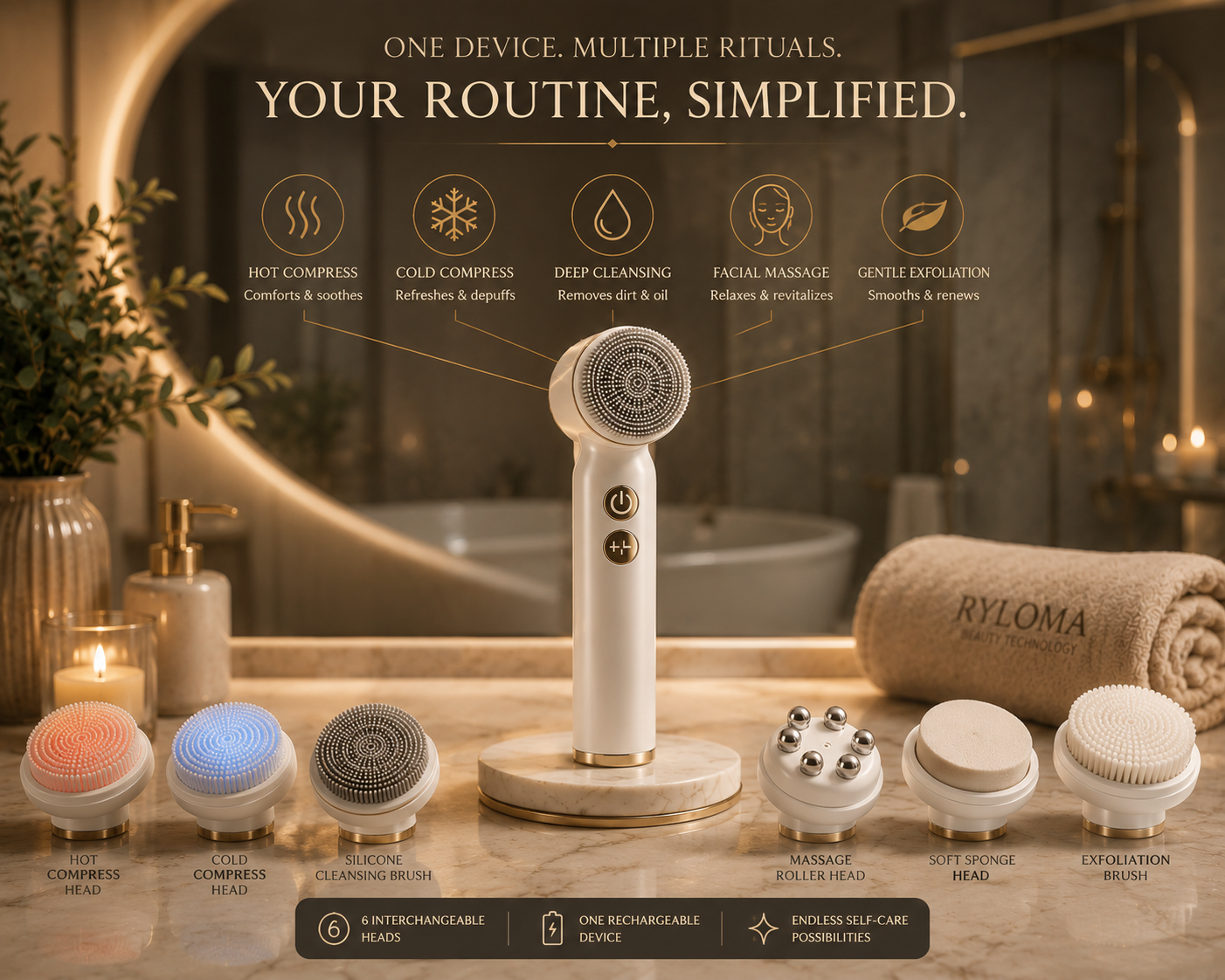
Explore GlowFusion’s Interchangeable Heads →The goal is not to purchase every technology listed above. Many multi-function devices combine several routines, while other users may only need one focused tool. The strongest value comes from identifying the recurring expense or inconvenience that matters most to you, then choosing a product you will realistically use.
A Simpler Approach
The goal isn't to build a collection of beauty devices. It's to build a routine you'll actually enjoy using.
Throughout this guide we've explored seven categories commonly found in professional beauty routines. That doesn't mean every category requires its own dedicated device. Modern beauty technology has evolved toward multi-function systems that bring several everyday routines together into one thoughtfully designed product.
For many people, that means less clutter on the bathroom counter, fewer chargers, fewer purchases and a routine that's easier to stay consistent with week after week.
Featured Solution
Designed around one simple idea: less equipment. More consistency.
Rather than purchasing separate tools for cleansing, massage, warming, cooling and exfoliation, GlowFusion combines multiple everyday skincare routines into one rechargeable system with interchangeable treatment heads.
For someone looking to simplify their skincare routine—not complicate it—that approach can make self-care easier to maintain while reducing the need to purchase multiple standalone devices.
GlowFusion won't replace every professional treatment, nor is it meant to. Its purpose is to make regular skincare more convenient, more consistent and easier to fit into everyday life.
Explore GlowFusion →Editor's Note
Professional spas, clinics and skincare specialists will always have an important place in the beauty industry. Expertise, personalized care and the experience itself cannot always be recreated at home.
The purpose of this article was never to suggest replacing every professional treatment. Instead, it was to explore where thoughtful technology may help reduce recurring expenses while making self-care more accessible and convenient.
The best investment isn't necessarily the most expensive device. It's the one that fits comfortably into your lifestyle and becomes part of a routine you'll still enjoy months—and years—from now.
— The Ryloma Editorial Team
Continue Your Journey
The Ryloma Journal was created for curious readers—not just shoppers. Explore practical guides, honest product reviews and thoughtful articles designed to help you make informed decisions about modern self-care.
Discover the hidden cost of recurring spa appointments—including something more valuable than money: your time.
A balanced look at what current research suggests, what realistic expectations look like and why consistency matters.
Discover why convenience, privacy and flexibility are changing how people approach their skincare and wellness routines.
"The future of beauty isn't about replacing professionals. It's about giving people more choice, more flexibility and more control over how they care for themselves."The Ryloma Editorial Team